The Permission to Fail
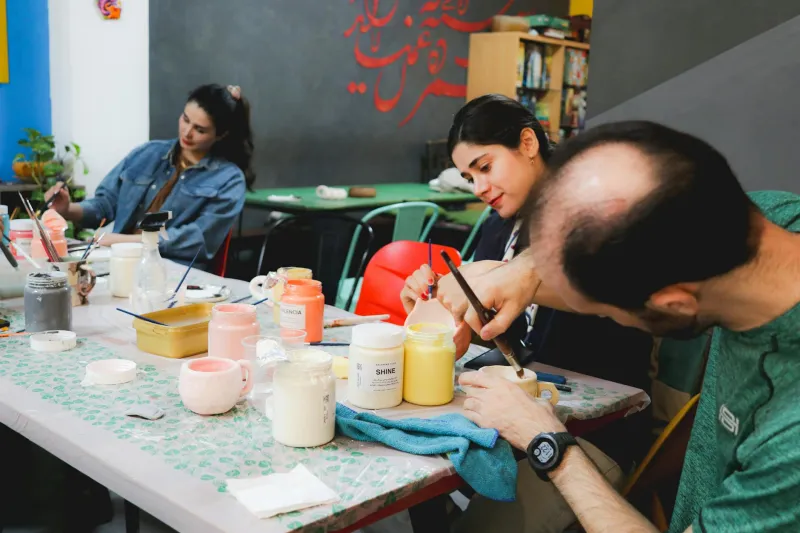
Every Tuesday evening at Hackney Community College, a remarkable transformation occurs. Barristers become beginners, consultants turn into novices, and senior managers submit themselves to the gentle tyranny of the pottery wheel. They arrive clutching coffee cups and shedding the professional competence that defines their daily lives, eager to embrace something increasingly rare in contemporary Britain: the permission to be utterly, joyfully terrible at something new.
This scene repeats itself across the country—in community centres, adult education colleges, and church halls—as Britain experiences an unexpected renaissance in amateur learning. The phenomenon extends far beyond traditional evening classes. Adults are enrolling in beginner's Italian despite having no plans to visit Rome, joining watercolour groups with no artistic ambitions, and attempting salsa dancing with the coordination of newborn giraffes.
What's driving this appetite for structured incompetence? The answer lies not in any practical utility, but in the profound psychological satisfaction of returning to a state of conscious ignorance.
The Tyranny of Instant Expertise
To understand the appeal of amateur education, one must first grasp what we've lost in the digital age. YouTube tutorials promise mastery in ten minutes; LinkedIn Learning certificates suggest competence can be downloaded; TikTok creators demonstrate complex skills in thirty-second clips. We inhabit a culture that has confused access to information with genuine learning, creating an illusion of effortless expertise.
This digital environment has produced what psychologist Sherry Turkle calls 'technological self'—identities shaped by the assumption that any skill can be rapidly acquired through the right app or video. The result is a generation of adults who've forgotten the essential human experience of sustained, incremental learning.
Amateur adult education offers a deliberate antidote to this culture of instant gratification. In a pottery class, clay refuses to cooperate with YouTube confidence. Spanish grammar resists the logic of Google Translate shortcuts. These activities demand something increasingly foreign to modern life: patience with one's own limitations.
The Ritual of Weekly Commitment
The structure of traditional adult education—weekly classes, term-based progression, physical attendance—creates something that online learning cannot replicate: ritual. The act of travelling to a specific place, at a specific time, to engage in a specific activity with the same group of people, establishes rhythms that our increasingly flexible, always-on culture has largely abandoned.
This ritualistic aspect proves particularly appealing to professionals whose work lives are characterised by constant connectivity and fluid boundaries. The pottery class or Spanish lesson represents a form of temporal sanctuary—a weekly appointment with focused attention that cannot be interrupted by emails or optimised through productivity apps.
Dr Sarah Chen, who studies adult learning patterns at the University of Birmingham, observes that participants often describe their classes using religious language: 'sacred time', 'weekly pilgrimage', 'communion with materials'. This suggests that amateur education fulfils needs that extend far beyond skill acquisition into the realm of spiritual and psychological restoration.
The Democracy of Struggle
Perhaps the most significant aspect of the amateur learning boom is its levelling effect. In a beginner's French class, the neurosurgeon struggles with pronunciation alongside the shop assistant; the investment banker's conjugations are no better than the retired teacher's. Professional hierarchies dissolve in the face of shared incompetence.
This democratic element proves particularly valuable in contemporary Britain, where educational credentials and professional achievements increasingly determine social stratification. The adult education classroom becomes one of the few remaining spaces where intelligence is measured not by prior accomplishment but by willingness to risk public failure.
The social dimension extends beyond mere equality of struggle. Regular classes create what sociologists call 'weak ties'—casual but meaningful connections that bridge different social worlds. These relationships, forged through shared vulnerability and mutual encouragement, often prove more psychologically sustaining than either close friendships or professional networks.
The Pedagogy of Presence
The persistence of in-person adult education, despite the availability of online alternatives, reveals something fundamental about how humans actually learn. The physical presence of an instructor—someone who can observe posture, correct technique, and respond to confusion in real-time—provides irreplaceable feedback loops.
More importantly, the classroom environment creates accountability structures that digital learning cannot match. The knowledge that others will witness your progress (or lack thereof) generates a productive form of social pressure. The weekly commitment to show up, regardless of mood or motivation, builds what psychologists call 'grit'—the capacity for sustained effort in pursuit of long-term goals.
This emphasis on process over outcome represents a profound shift from Britain's increasingly results-oriented culture. Adult education classes succeed precisely because they prioritise engagement over achievement, effort over excellence.
The Economics of Enrichment
The amateur learning boom also reflects changing economic realities. As traditional career paths become less predictable and retirement ages extend, many adults find themselves with both the motivation and resources to pursue learning for its own sake. The cost of a pottery class—typically £120 for a ten-week term—represents accessible luxury for middle-class professionals seeking meaningful ways to spend discretionary income.
Local authorities, despite budget constraints, have recognised adult education's value in community building and mental health support. Many councils now frame evening classes not as educational services but as preventative healthcare, understanding that regular, social, purposeful activity contributes significantly to wellbeing among older adults.
The Resistance to Optimisation
What makes amateur adult education particularly subversive in contemporary Britain is its resistance to optimisation. These activities cannot be 'hacked' or made more efficient. Clay takes as long as it takes to centre; Spanish irregular verbs must be memorised through repetition; watercolour techniques develop through practice, not through productivity strategies.
This stubborn inefficiency proves liberating for adults accustomed to maximising every moment. The pottery wheel becomes a meditation on patience; the language class teaches humility; the art group celebrates process over product. These lessons, while ostensibly about craft skills, actually address deeper needs for deceleration and acceptance of imperfection.
Community in the Age of Algorithms
Ultimately, Britain's amateur learning renaissance represents a form of quiet rebellion against the algorithmic organisation of modern life. In an age where social media platforms curate our connections and recommendation engines determine our cultural consumption, the random assembly of adults united only by shared curiosity creates genuinely unpredictable social encounters.
The success of amateur adult education suggests that beneath Britain's efficiency-obsessed surface lies a deeper hunger for experiences that cannot be optimised, relationships that cannot be networked, and learning that serves no purpose beyond the joy of gradually, imperfectly, getting better at something worth doing badly.
This renaissance reminds us that education, at its best, is not about acquiring marketable skills or professional advancement, but about the fundamental human pleasure of discovering what we didn't know we didn't know.