Shelved Ambitions: What the Books You Never Read Say About Who You Wish You Were
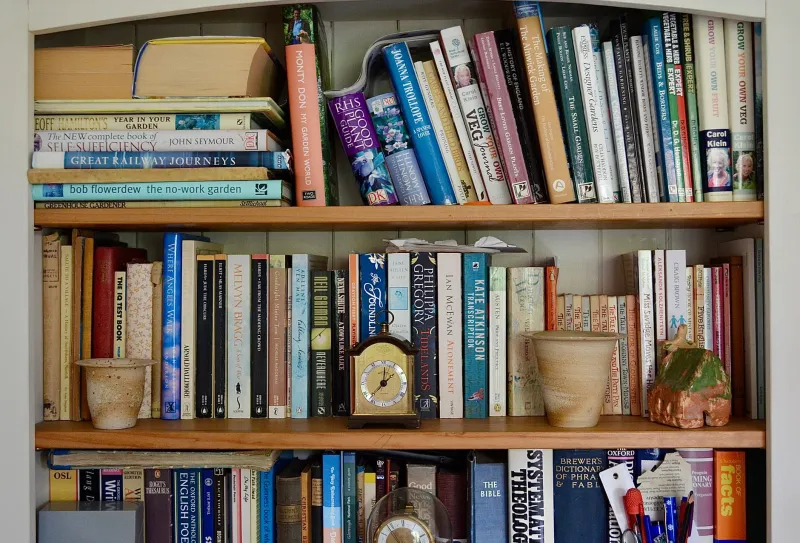
There is a particular species of British home that announces itself the moment you cross the threshold. The bookshelves arrive before the introductions do — floor-to-ceiling arrangements of spines so artfully positioned, so precisely colour-coordinated or deliberately dishevelled, that you understand immediately you are in the presence of someone who has given considerable thought to how little thought they appear to have given. The Collected Works of Proust sits adjacent to a battered Penguin paperback of Middlemarch. A Jonathan Franzen novel leans companionably against something in translation. Everything whispers: I am the sort of person who reads.
The question nobody asks at the dinner party, of course, is whether any of it has actually been read.
The Aspirational Anthology
Britain has always maintained a peculiar relationship with the idea of literary seriousness. We are a nation that considers reading a moral virtue — the sort of activity that signals not merely intelligence but character, restraint, and a commendable resistance to vulgarity. To read is to be, in some inherited Protestant sense, improving oneself. The bookshelf, therefore, has never been a neutral piece of furniture. It is a testimony.
What has shifted in recent years is the degree to which that testimony has become consciously curated. The rise of the photogenic home — catalysed by Instagram, Pinterest, and an entire ecosystem of interiors content — has transformed the bookshelf from a storage solution into a stage set. Entire businesses now exist to supply homeowners with books sold not by their contents but by their aesthetic properties: the right height, the right hue, the right degree of weathered authenticity. You may purchase a shelf-metre of vintage hardbacks in coordinated earth tones without any obligation to investigate their arguments.
This is not, in itself, a new phenomenon. The Victorians kept improving literature prominently displayed in drawing rooms with much the same theatrical intention. But the contemporary version carries a particular self-consciousness that its predecessors lacked. We know we are performing. We simply choose to perform anyway.
The Taxonomy of the Unread
Any honest audit of a British bookshelf will reveal a fairly consistent taxonomy. There are the Purchased-with-Genuine-Intention titles — the Booker longlists acquired in a burst of autumnal enthusiasm, the biography of a historical figure whose Wikipedia entry you found compelling, the popular science book about consciousness that seemed entirely manageable until page forty-seven. These are the books that carry the faint stigma of the bookmark abandoned at chapter three.
There are the Gifted Volumes, which occupy a category unto themselves. These cannot be removed from display without risking inference by the giver, and so they remain, monuments to someone else's sense of who you ought to be. A surprising number of British bookshelves contain at least one copy of Sapiens in this condition.
Then there are the Aspirational Classics — the Tolstoys, the George Eliots, the complete works of someone formidably European — which function less as reading matter than as architectural statements. Their presence communicates something about the owner's self-conception that their actual reading habits would flatly contradict.
Finally, and perhaps most poignantly, there are the books one has genuinely read and loved but which are hidden in a bedroom or a box room because they are the wrong sort of books: the crime novels, the fantasy series, the celebrity memoirs consumed with genuine pleasure and now quietly exiled from the public-facing shelves.
The Honesty of the Shelf
And yet — and this is where the analysis becomes more generous — there is an argument that the unread bookshelf is not purely an exercise in self-deception. It may, in fact, represent something more interesting: the physical architecture of aspiration.
To own a book is to enter into a relationship with its possibility. The unread Anna Karenina on your shelf is not evidence of failure so much as a standing invitation — a version of yourself you have not yet become but have not entirely abandoned. There is something quietly moving about that. The British tendency to acquire books with earnest intent and then allow life to intervene is less a character flaw than a record of good intentions meeting the ordinary entropy of existence.
The literary scholar and cultural commentator Marina Warner once observed that libraries are always partly about the future. The same might be said of the domestic bookshelf. It is a map of roads not yet taken, annotated with optimism.
The Instagram Shelf and Its Discontents
Where this becomes more troubling is in the deliberate staging of the shelf for external consumption. The bookshelf that appears in the background of a carefully composed photograph — or, worse, the shelf assembled specifically to appear in photographs — represents a more calculated form of performance. Here, the books are not aspirational in any meaningful sense. They are props.
This practice has attracted sufficient cultural attention that it has generated its own counter-movement: the conspicuously messy bookshelf, the deliberately unflattering pile of dog-eared paperbacks, the proud display of genre fiction as an act of anti-elitist positioning. But this, too, is a performance. The authenticity is as curated as the colour-coordination it replaces.
Perhaps what the British bookshelf ultimately reveals is not our hypocrisy but our hunger — for intellectual life, for cultural seriousness, for a version of ourselves that reads more, thinks more, and sits quietly with difficult ideas more than our actual lives permit. The shelf is a portrait of the person we are trying to become, painted in someone else's words.
What We Owe the Unread
There is a reasonable case that we should be kinder to ourselves about this. The modern British professional life — fragmented, screen-saturated, perpetually interrupted — is not a hospitable environment for sustained reading. The average commute is now more likely to involve a podcast than a paperback. The evening hours that once belonged to novels have been colonised by streaming services of considerable quality and essentially infinite supply.
The books remain on the shelves not as monuments to failure but as evidence that we have not entirely surrendered to the path of least resistance. They are, in their patient, unread way, an act of quiet resistance.
Or perhaps that, too, is a story we tell ourselves. The truth, as with most things British, probably lies somewhere in the middle: part vanity, part hope, part the entirely human desire to be seen as someone worth knowing. The bookshelf, in the end, is not a library. It is a self-portrait, painted in spines, and like all self-portraits, it tells you as much about the gap between reality and aspiration as it does about either one alone.