The Commodified Sublime
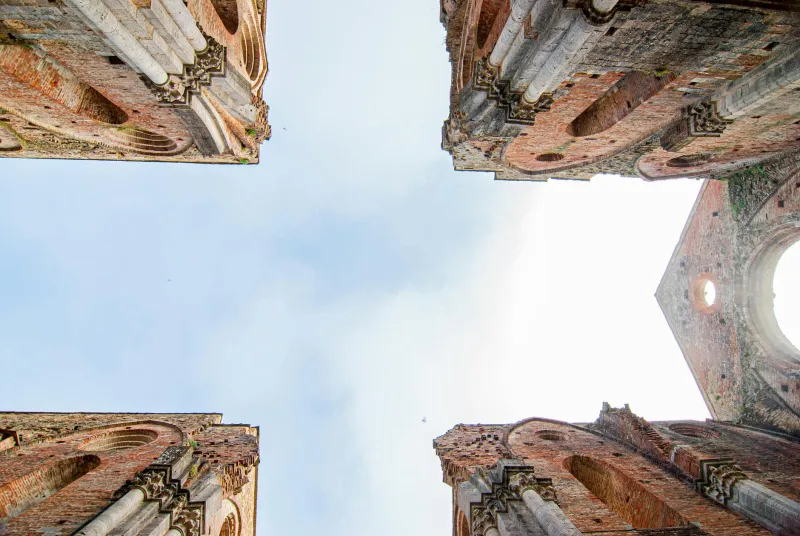
Standing in the shadow of Fountains Abbey on a drizzling Tuesday morning, one cannot help but notice the curious choreography unfolding amongst the medieval stones. Young visitors arrive not with guidebooks or quiet contemplation, but with ring lights and smartphone tripods, transforming Cistercian arches into elaborate selfie stations. The romantic ruin—once Britain's most potent symbol of beautiful decay and temporal reflection—has become something altogether different: content.
This transformation represents more than mere technological adaptation. For three centuries, Britain's relationship with its own ruins has defined our cultural DNA, from the Gothic novels of Ann Radcliffe to the watercolours of Turner. These crumbling monuments to lost power and forgotten faith offered something uniquely British: the ability to find profound beauty in decline, to discover meaning in moss and majesty in collapse.
Yet today's visitors to Tintern Abbey or Hadrian's Wall arrive with fundamentally different expectations. Where the Romantics sought transcendence through contemplation of mortality, contemporary ruin-tourists seek validation through digital engagement. The sublime has been replaced by the 'grammable.
The Democratisation Paradox
The irony, of course, is that this apparent vulgarisation represents a kind of democratic victory. For centuries, Britain's ruins were largely the preserve of the educated elite—gentlemen scholars on Grand Tours, artists seeking picturesque subjects, poets mining metaphors from medieval masonry. The working classes who built these monuments rarely returned to contemplate their decay.
Social media has shattered these cultural gatekeeping mechanisms. A teenager from Coventry can now experience Rievaulx Abbey with the same ease as a Cambridge don, sharing their encounter with thousands of followers who might never have considered visiting such places. The question is whether this democratisation has enriched or impoverished the encounter itself.
Consider the recent phenomenon of 'dark academia' aesthetics on platforms like TikTok, where young creators stage elaborate photo shoots amongst Gothic Revival architecture, wearing flowing coats and clutching leather-bound volumes. These performances represent a genuine hunger for connection with Britain's literary and architectural heritage, yet they also reduce complex historical narratives to a series of visual tropes.
The Heritage Industry's Dilemma
English Heritage and the National Trust find themselves caught in an impossible bind. Rising maintenance costs demand increased visitor numbers, yet the very presence of crowds threatens the contemplative atmosphere that makes these sites meaningful. The solution has been to embrace what might be called 'experiential heritage'—augmented reality tours, immersive installations, and carefully curated 'Instagram moments' designed to encourage social sharing.
This strategy has proved financially successful but culturally complex. Warwick Castle's medieval tournaments and Tower of London's Beefeater performances draw substantial crowds, yet they also transform authentic historical sites into theme park approximations of themselves. The ruin becomes a stage set for our own fantasies about the past rather than a genuine encounter with historical reality.
More troubling still is the emergence of what cultural critic Robert Macfarlane terms 'ruin porn'—the fetishisation of decay divorced from its historical context. Abandoned factories in Detroit receive the same aesthetic treatment as Glastonbury Abbey, flattening centuries of cultural significance into a generic appreciation of photogenic dereliction.
Digital Pilgrimage and Authentic Experience
Yet perhaps we are too quick to dismiss these new forms of engagement. The young woman carefully positioning herself amongst the ruins of Whitby Abbey for a photograph is not necessarily engaging with the site less authentically than the Victorian gentleman who sketched the same arches for his private portfolio. Both are attempting to capture and preserve their encounter with the sublime, using the technologies available to their respective eras.
The difference lies not in the act of documentation but in its intended audience. Where the Victorian sketch was a private aide-memoire, the Instagram post is a public performance, shaped by the expectations and algorithms of social media platforms. This fundamental shift from private contemplation to public display inevitably alters the nature of the encounter itself.
Reclaiming Ruins
Some institutions are attempting to navigate this tension more thoughtfully. The National Trust's recent 'Wild Ruins' initiative encourages visitors to experience sites like Corfe Castle and Old Wardour during off-peak hours, emphasising quiet contemplation over digital documentation. These programmes acknowledge that meaningful engagement with Britain's ruins requires time, silence, and the kind of sustained attention that social media actively discourages.
Similarly, projects like the Romantic Ruins Foundation work to contextualise contemporary ruin-tourism within longer historical traditions, demonstrating that every generation has found its own ways to instrumentalise decay for contemporary purposes.
The Future of Romantic Decay
Britain's ruins will survive this latest transformation, as they have survived centuries of changing fashions and purposes. Medieval monasteries became Georgian follies, which became Victorian tourist attractions, which have now become digital content. Each era projects its own anxieties and aspirations onto these ancient stones.
The challenge for contemporary Britain is ensuring that our relationship with ruins remains genuinely transformative rather than merely transactional. This requires defending spaces for contemplation within our increasingly commodified cultural landscape, while acknowledging that new forms of engagement might offer their own kinds of meaning.
Perhaps the true ruin in need of restoration is not architectural but cultural—our collective capacity for the kind of sustained, reflective engagement that allows ancient stones to speak across centuries. In an age of infinite scroll and endless notification, the radical act may simply be standing still long enough to listen.