Greasepaint and Grief: How Britain's Am-Dram Rooms Became Our Most Honest Confessionals
Greasepaint and Grief: How Britain's Am-Dram Rooms Become Our Most Honest Confessionals
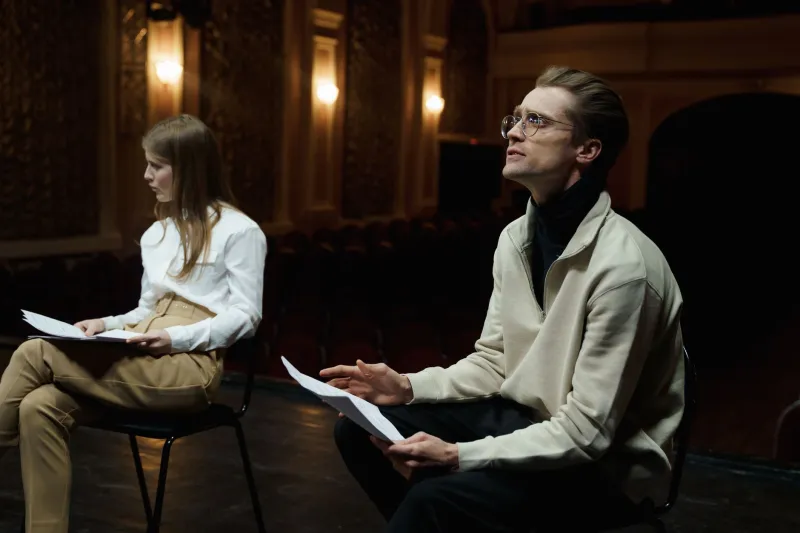
The heating in the Elmbridge Players' rehearsal room is, by any reasonable standard, a work of fiction. It rattles, it promises, it occasionally delivers a brief and unconvincing warmth before retreating entirely. The folding chairs are the kind that leave geometric impressions on the backs of thighs. The tea is stewed. And yet, on a wet Wednesday evening in November, fourteen adults between the ages of thirty-eight and sixty-seven are giving what can only be described as the most emotionally committed performances of their week.
 Photo: Elmbridge Players, via p-j-production.com
This is not a scene particular to Elmbridge, wherever Elmbridge may be. Across Britain — in draughty church halls in Northumberland, in converted scout huts in the Cotswolds, in the upstairs rooms of pubs in Salford that still smell faintly of the nineties — amateur dramatic societies are experiencing something that demographers cautiously describe as a revival, and that participants describe, when pressed, as a lifeline.
The Numbers Behind the Curtain
The Little Theatre Guild, which represents some sixty-odd amateur companies across England and Wales, has reported consistent growth in membership enquiries since 2021. The National Operatic and Dramatic Association, the umbrella body for amateur theatre in the UK, counts over 2,500 affiliated groups and estimates that nearly a quarter of a million people participate in amateur performance annually. These figures, remarkable in themselves, tell only part of the story. The more revealing statistic is the demographic one: the fastest-growing cohort joining am-dram societies is not the drama school aspirant in their twenties, but the professional in their mid-forties who has never previously set foot on a stage and cannot entirely explain why they have done so now.
The reasons they offer, when asked, are instructive in their evasiveness. 'I fancied trying something different,' is common. So is 'my colleague dragged me along.' Rarely does anyone say, in the initial conversation, that they are profoundly lonely, or that they have not cried properly in three years, or that inhabiting a character for two hours a week has given them access to emotions they had entirely misplaced somewhere between the mortgage and the performance review cycle. But spend enough time in these rooms, and the subtext becomes impossible to ignore.
The Permission Structure of Pretending
There is a particular freedom, it turns out, in being allowed to be someone else. Not the freedom of escapism — that is a different and lesser thing, available via Netflix at considerably less personal cost — but the freedom of structured emotional permission. When a fifty-two-year-old quantity surveyor from Lichfield plays Chekhov's Uncle Vanya, he is not escaping his own disappointments. He is, with the full sanction of the director and the text, exploring them through a different vessel. The displacement is the point.
Psychologists who work adjacent to the performing arts have long understood the therapeutic dimensions of role-play and embodied experience. Dramatherapy is a recognised clinical practice. What is less acknowledged is the degree to which the village hall production of Noises Off is doing, informally and accidentally, something not entirely dissimilar. The structure of rehearsal — the repetition, the collective vulnerability, the iterative process of getting something wrong and trying again — mirrors, at a certain oblique angle, the structure of good therapeutic work.
'Nobody comes here and says they need help,' one director of a Shropshire society told me, with the measured understatement of someone who has watched many people come, ostensibly, for help. 'But you watch someone play a character who is furious, or bereft, or terrified, and you see something happen in them. Something loosens.'
The Particular Catharsis of Playing the Villain
If there is one role that reveals the therapeutic appetite of the am-dram revival most clearly, it is the villain. Pantomime season, which occupies the winter months for societies across the country, functions as a remarkable pressure valve. The opportunity to perform malice — to boo, to scheme, to sneer at an audience of gleefully complicit strangers — is one that participants describe with a fervour that goes well beyond theatrical enthusiasm.
This is not, one suspects, coincidental. Britain in the mid-2020s is a country that has become extraordinarily proficient at suppressing its darker registers. The cultural premium placed on positivity, resilience, and the performance of contentment — on social media, in the workplace, at the school gate — has left many people with what one might describe as an emotional surplus of the inconvenient kind. The pantomime villain offers a socially sanctioned container for it. The booing is the point. The excess is the point.
Community as a Byproduct of Art
What the am-dram revival also offers, and what is perhaps its most quietly radical dimension, is the particular quality of community that emerges from shared creative risk. This is different from the community of the book club or the running group or the WhatsApp collective organised around school pickups. It is forged through mutual embarrassment, through the shared knowledge of having forgotten one's lines, through the intimacy of being seen to try something and fail and try again.
In an era when friendship has been increasingly theorised and optimised — when we speak of 'maintaining relationships' with the language of infrastructure management — there is something genuinely subversive about a community that forms around the act of being, together, a little bit ridiculous.
The draughty room, the stewed tea, the heating that lies: these are not incidental inconveniences. They are, in their way, the point. They are what remains when the polish is stripped away, and what remains turns out to be rather more sustaining than anything you might find at a wellness retreat.
Britain, it seems, has found its therapy. It just happens to wear a cape and require a working knowledge of Act Two.