The Last Polite Room: In Defence of the Quiet Carriage
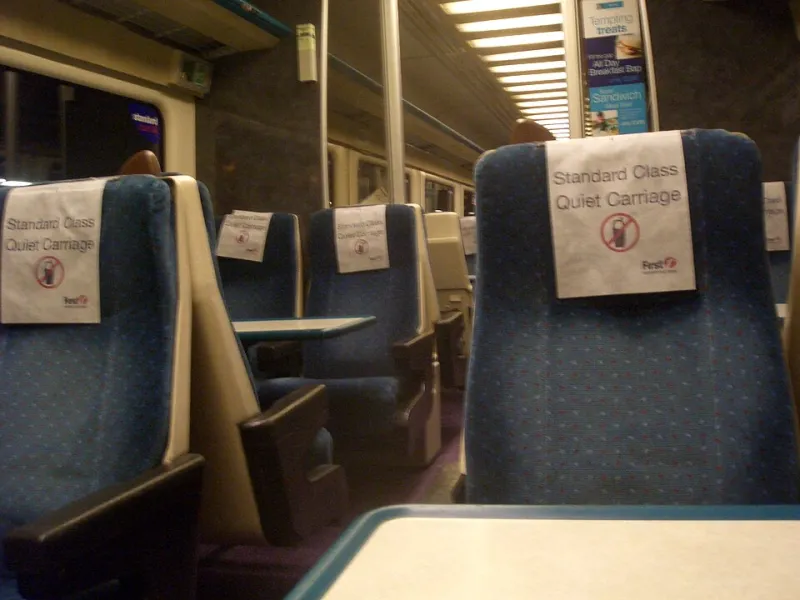
Photo: No machine-readable author provided. Edward assumed (based on copyright claims)., Public domain, via Wikimedia Commons
There is a particular kind of silence on the 07:42 to Euston. It is not the silence of an empty room, but the active, self-conscious silence of people who have agreed, without ever signing anything, not to make one another’s journey worse. The quiet carriage is one of the last great social contracts in Britain. It is also one of the most frequently broken. That contradiction is precisely why it matters.
An Unwritten Act of Parliament
The rules are simple and nowhere legally enforceable. No phone calls. Headphones at a volume that does not leak. No impromptu meetings. No tinny podcasts. No prolonged rustling of crisp packets at 7.15 in the morning. In return, the quiet coach offers a rare public good: a space where attention is not constantly requisitioned by somebody else’s device. It is a small, moving sanctuary in a country that often seems to have forgotten how to be quietly together.
What makes the quiet carriage interesting is not the silence itself. It is the enforcement. There is no police officer of the hush, no formal penalty for the man who takes a call to explain, at length, that he is ‘just getting on the train now’. Instead, there is a delicate apparatus of social pressure: the pointed glance, the theatrical sigh, the deliberate clearing of a throat. Occasionally, a passenger will say something. The brave shush is a remarkable act of civic courage, precisely because it risks a scene in a space dedicated to avoiding one.
The Moral Economy of the Hush
We tend to talk about public space as if it were either free and unrestricted or regulated and policed. The quiet carriage suggests a third possibility: a space governed by voluntary restraint. It works because most people want it to work. The rule is not imposed from above; it is maintained by mutual expectation. That is a fragile thing, but it is also a sophisticated one. It asks passengers to moderate their own behaviour not because they will be punished, but because they recognise that others have a claim on the atmosphere.
This is unfashionable. We live in an age that treats personal expression as an absolute good and inconvenience as an affront. The phone call is not merely a call; it is a statement that one’s own business takes precedence over the shared room. The quiet carriage resists that logic. It says that there are places where the collective hush is more valuable than the individual voice. It says that restraint is not repression. It says that a society can ask its members to be slightly less themselves for the benefit of everyone else.
When the Contract Frays
The quiet coach also exposes the limits of British civility. We are good at sighing; we are less good at confronting. The result is a strange passive-aggressive ecosystem in which everyone knows the rule and almost everyone resents the person who breaks it, but few are willing to enforce it directly. The quiet carriage thus becomes a moral test not of the offender but of the rest of us. Do we speak up? Do we seethe? Do we move to another carriage and compose a mournful post on social media?
The failures are instructive. A phone call taken in the quiet coach is not usually an act of malice. It is an act of thoughtlessness, or of main-character syndrome, or of the simple belief that rules are for other people. But the effect is cumulative. One call makes another call possible. One leaking headphone encourages another. The quiet carriage depends on a critical mass of compliance; once that mass erodes, the space becomes merely another carriage with better intentions.
A Small Model of Civic Life
It would be easy to romanticise the quiet coach as a relic of a more polite Britain. That would be a mistake. The quiet carriage is not a museum piece; it is a live experiment in shared restraint. It shows that people will accept boundaries if those boundaries are clear, reasonable and widely held. It shows that public space can be more than a container for private consumption. It shows that silence is not the absence of society but one of its achievements.
In a noisy, phone-lit age, that is worth defending. The quiet carriage is not merely for people who want to work or sleep. It is for anyone who wants proof that strangers can still be considerate without being told. The contract is unwritten, but it is not imaginary. It is renewed every time a passenger lowers their voice, silences a notification, or catches the eye of someone with a screaming phone and gives the smallest, most British of shrugs.
We should protect that. Not with more signs, necessarily, but with more willingness to treat the quiet coach as what it is: a small, fragile, civilising agreement. The last polite room in Britain may not be a room at all. It may be a carriage, moving north, in which everyone has quietly agreed to behave.